Telemedicine & Digital Twins: Next Horizon of India's Health Equity
India’s healthcare transformation is shifting from a phase of physical expansion to one of digital precision. While the nation has made monumental strides in infrastructure, the "specialist gap" remains a stark reality. Digital technologies are no longer just supplementary tools; they are the primary architecture for bridging the rural-urban divide and ensuring Health Justice for every citizen.
1. Telemedicine: From Emergency Response to Clinical Standard
Telemedicine has matured beyond simple video consultations into a sophisticated ecosystem of remote clinical delivery.
- The Regulatory Backbone: With the 2020 Telemedicine Practice Guidelines and the Ayushman Bharat Digital Mission (ABDM), India has created a world-class framework for clinical accountability in a virtual space.
- The MedTech Enabler: The true power of telemedicine lies in Connected MedTech. Advanced wearables, portable point-of-care diagnostics, and Tele-ICU modules allow a specialist in a metro hub to manage a critical patient in a remote district with real-time, high-fidelity data.
- Impact on Equity: By decentralizing expertise, we are moving toward a "Hospital-at-Home" model, reducing the catastrophic out-of-pocket expenses patients face when traveling for basic specialist advice.
2. Digital Twins: The Frontier of Predictive Precision

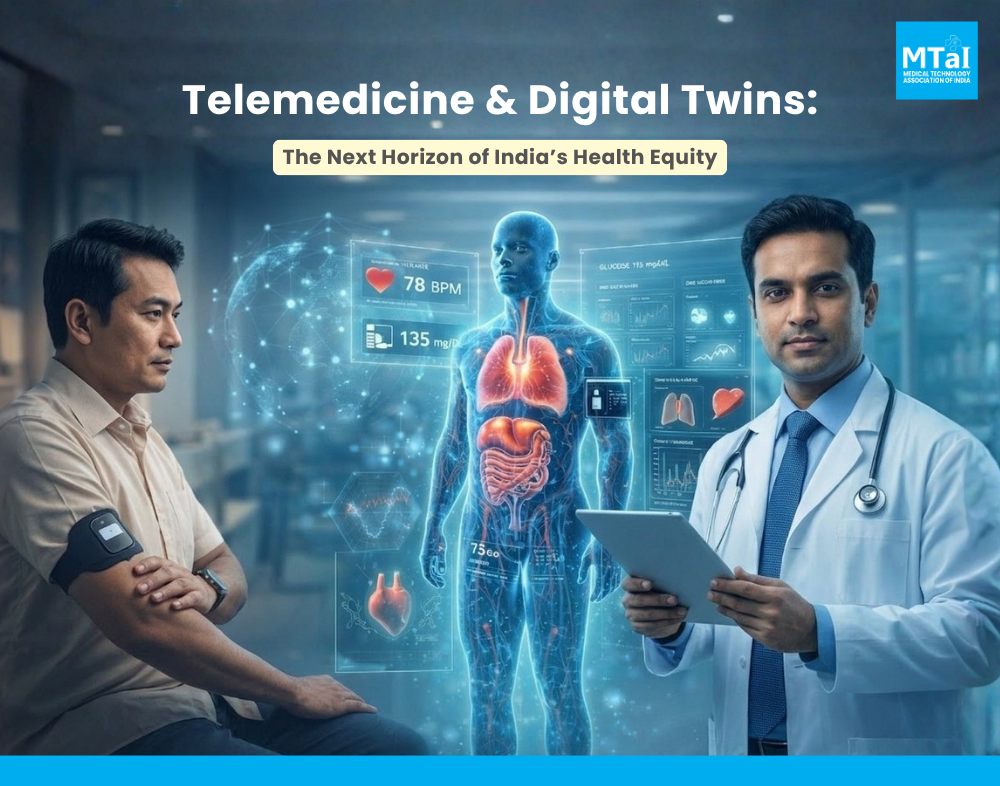
If Telemedicine solves for Access, Digital Twins solve for Outcomes. A "Digital Twin" is a dynamic, virtual replica of a biological system-be it a single organ or a patient’s entire physiology.
- Precision Medicine: By integrating data from imaging, genomics, and IoT sensors, clinicians can simulate a surgery or test a drug’s efficacy on a virtual model before touching the patient.
- Managing the NCD Burden: For India’s growing diabetic and cardiovascular patient base, Digital Twins offer a "look-ahead" capability, predicting complications months before they manifest clinically.
- Systemic Efficiency: Beyond the patient, digital twins of entire hospital workflows allow administrators to optimize resource utilization, ensuring that life-saving equipment is where it needs to be, exactly when it is needed.
“The convergence of remote access and virtual simulation represents a fundamental shift: we are moving from reactive treatment to predictive, data-driven wellness.”
3. The MedTech Ecosystem: Building the Foundation
The transition to a digital-first healthcare system rests on three strategic pillars:
- Interoperability: Data must flow seamlessly between a wearable device, a government health ID (ABHA), and a tertiary hospital’s EMR.
- Cyber-Resilience: As healthcare becomes data-centric, protecting patient privacy through robust cybersecurity is a non-negotiable prerequisite for trust.
- Standardization: MTaI continues to advocate for global standards in digital health to ensure that Indian innovations are scalable and compatible with international best practices.
The Path Forward
For India, embracing Telemedicine and Digital Twins is not a technological luxury-it is a strategic imperative. This evolution will redefine the "Standard of Care," ensuring that a patient's geography no longer dictates their clinical destiny.
Through collaborative policy-shaping and sustained innovation, the MedTech industry is committed to building a healthcare system that is resilient, equitable, and future-ready.